

Article 3: The Economic and Social Case for Educating Women
Economists and development researchers have spent decades documenting what may be one of the most consistently replicated findings in the social sciences: investing in girls’ and women’s education produces measurable, wide-ranging benefits that extend well beyond the individual student, touching family health, national economic output, and even the educational outcomes of the next generation. This body of evidence has helped transform girls’ education from a matter viewed primarily through the lens of fairness into one increasingly recognized as sound economic policy as well.
Individual Earnings and Opportunity
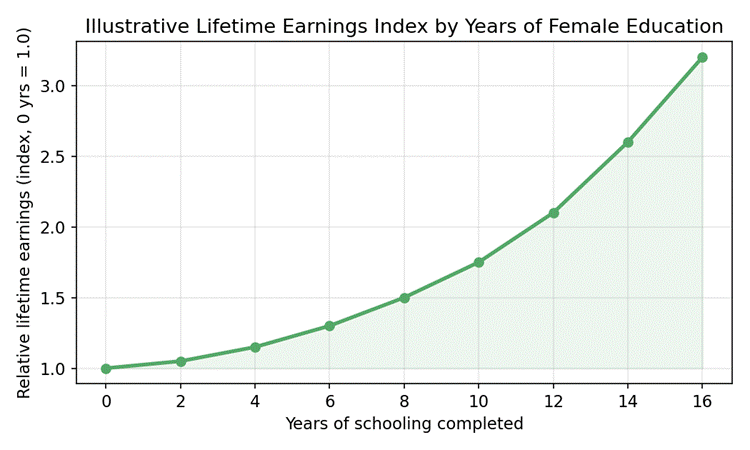
At the most basic level, additional years of schooling translate into higher lifetime earnings, and this relationship holds with particular strength for women. World Bank research has found that each additional year of secondary education for girls can increase their future earnings by a meaningful percentage, with the effect compounding as education levels rise, since more education typically opens access to higher-skilled, better-compensated employment that would otherwise remain closed. Educated women are also significantly more likely to participate in the formal labor force at all, rather than being confined to unpaid domestic labor or the informal economy, where wages tend to be lower and protections minimal.
Figure 3: Illustrative relationship between years of female education completed and relative lifetime earnings.
National Economic Growth
The benefits of women’s education scale up meaningfully at the national level as well. Research by organizations including the World Bank and the McKinsey Global Institute has estimated that closing gender gaps in education and labor force participation could add trillions of dollars to global economic output, reflecting the enormous cost of underutilized human capital in economies where large numbers of educated women remain outside the formal workforce or are steered into a narrow band of lower-paying occupations. Countries that have invested heavily in girls’ education alongside broader economic reforms, including several economies across East Asia in recent decades, have often seen this investment cited as a meaningful contributor to their periods of rapid growth.
Educated women also tend to have smaller families and to have children later in life, a pattern that has significant demographic and economic implications, contributing to the kind of demographic transition, discussed in earlier population-focused research, that has historically accompanied periods of rapid economic development. This is not primarily a matter of external population policy but rather a well-documented consequence of women having greater autonomy over their own reproductive choices once they have access to education and economic opportunity.
Health Outcomes for Women and Children
Perhaps the most striking body of evidence concerns the relationship between maternal education and child health. Children born to more educated mothers consistently show lower rates of infant and child mortality, better nutritional outcomes, and higher rates of immunization, even after controlling for household income, a pattern that researchers attribute to a combination of factors, including greater health literacy, more autonomy in household decision-making, and better ability to navigate healthcare systems. Maternal education is also strongly associated with lower maternal mortality, since educated women are more likely to seek prenatal care, deliver with a skilled birth attendant, and recognize warning signs that require medical attention.
These health benefits extend across generations. A mother’s education level is one of the strongest predictors of whether her own children, particularly her daughters, will complete their schooling, creating a virtuous cycle in which investments in girls’ education today compound into benefits for subsequent generations, a dynamic that development economists sometimes describe as one of the highest-return investments available in low-income settings precisely because its benefits are so broadly distributed across health, economic, and educational outcomes simultaneously.
Broader Social and Political Effects
Beyond economics and health, women’s education has been linked to a range of broader social outcomes, including greater political participation and representation, as educated women are statistically more likely to vote, run for office, and engage in civic life. Some research has also found associations between higher levels of female education and reduced rates of gender-based violence, potentially reflecting both greater economic independence, which can make it easier for women to leave abusive situations, and shifting social norms in communities where women’s education is more broadly valued and normalized.
An Investment, Not Just an Entitlement
Taken together, this evidence has reframed how many governments, international organizations, and development agencies approach the question of girls’ education. Where the case was once made primarily on grounds of equity and human rights, powerful arguments in their own right, it is increasingly also made on the grounds of economic self-interest: few investments available to low- and middle-income countries offer a comparable combination of economic, health, and social returns as ensuring that girls complete their education, a conclusion that has helped mobilize substantial new funding and policy attention toward closing the remaining gaps described elsewhere in this series.