

Article 4: Women in Higher Education and STEM Fields
One of the more remarkable demographic shifts in global education over the past half-century has been the reversal of the gender gap in higher education enrollment. In much of the world today, including the United States, most of Europe, and increasingly Latin America and parts of Asia, women now earn the majority of university degrees, a striking change from a century ago when women’s access to higher education was the exception rather than the rule. Yet this overall convergence masks a persistent and much-discussed gap in one particular set of fields: science, technology, engineering, and mathematics, commonly known as STEM.
The Overall Gender Enrollment Reversal
UNESCO data shows that women now make up slightly more than half of university students globally, and in many high-income countries the gap in women’s favor is substantial, with women earning a clear majority of bachelor’s and master’s degrees awarded each year. This shift has occurred across a wide range of fields, including education, health sciences, humanities, and social sciences, where women often represent a strong majority of graduates. The reversal reflects several converging factors, including the elimination of formal barriers to women’s higher education enrollment across most of the world, strong labor market returns to a degree that have made higher education increasingly attractive to women, and, according to some researchers, differences in average academic performance during secondary school that have tended to favor girls in recent decades.
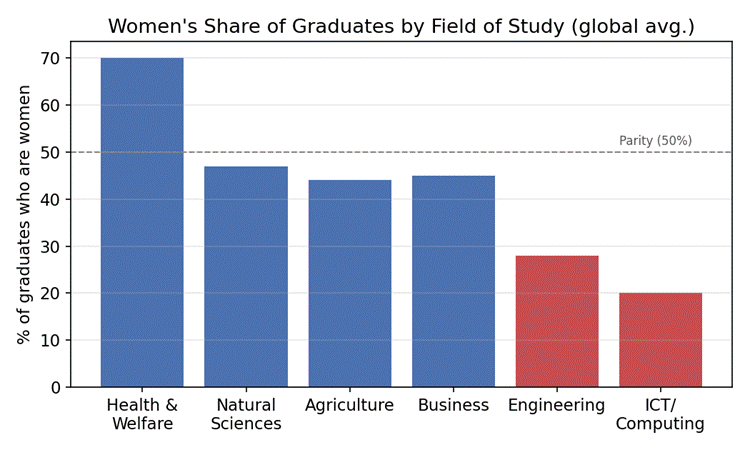
Figure 4: Women’s share of university graduates by field of study, illustrating strong representation in some fields and a persistent gap in others.
The Persistent STEM Gap
Despite this broader convergence, women remain significantly underrepresented in several STEM fields, particularly engineering and computer science, where global figures typically show women earning somewhere between a fifth and a third of degrees awarded, a gap that has proven far more resistant to change than overall higher education enrollment. Interestingly, the gap varies considerably by country in ways that complicate simple explanations; several countries with lower overall gender equality rankings on other measures have nonetheless produced comparatively higher shares of women engineering graduates than some wealthy Western nations, a pattern that researchers have linked to differing cultural narratives about the perceived difficulty, prestige, and gender-appropriateness of technical careers.
Computer science presents a particularly striking case, in part because the field’s gender composition has not always looked the way it does today. In the early decades of computing, women made up a substantial share of programmers, and some of the field’s pioneering figures, including Ada Lovelace in the nineteenth century and figures such as Grace Hopper in the twentieth, were women. The share of women in computer science degree programs in the United States actually declined significantly from the mid-1980s onward, a shift that researchers have partly attributed to the rise of home computing being marketed disproportionately toward boys during that era, shaping a generation’s assumptions about who computing was ‘for’ well before students reached university.
The Leaky Pipeline
Researchers studying women’s underrepresentation in STEM careers often describe a ‘leaky pipeline,’ in which women who do enter STEM fields depart at higher rates than men at various career stages, including after completing a degree, during early career years, and especially around the transition to more senior positions. Surveys of women who have left STEM careers frequently cite a combination of factors, including workplace cultures perceived as unwelcoming or exclusionary, a lack of visible mentors and role models in senior positions, and the disproportionate difficulty of balancing demanding STEM career trajectories with caregiving responsibilities that continue to fall more heavily on women in most societies.
A number of universities, professional societies, and technology companies have launched targeted initiatives in response, including mentorship programs, all-women coding bootcamps, scholarships specifically for women in STEM fields, and efforts to redesign introductory courses to reduce the intimidation factor that has been shown to disproportionately discourage women, particularly those without significant prior exposure to a subject like computer science, from continuing in the field.
Graduate Study and Academic Careers
The gender gap tends to widen further at each successive stage of academic advancement in STEM fields. Women who earn STEM bachelor’s degrees are somewhat less likely than men to pursue doctoral study in the same field, and women who complete STEM doctorates are, in turn, less likely to secure and retain tenure-track faculty positions, a pattern sometimes described as an academic pipeline that narrows further at each transition. Efforts to address this have included revised parental leave and tenure clock policies at many universities, blind review processes for hiring and grant funding intended to reduce unconscious bias, and dedicated funding initiatives, including some run by national science agencies, aimed specifically at supporting women’s research careers in underrepresented fields.
Signs of Gradual Progress
While the STEM gender gap remains substantial, most available data suggests it has been narrowing gradually over time, particularly in fields such as biology and chemistry, where women now often make up a majority or near-majority of graduates in many countries, a reminder that ‘STEM’ is not a monolithic category and that progress has been considerably faster in some technical fields than others. Whether similar progress can be achieved in the most persistently male-dominated fields, particularly engineering and computer science, likely depends on sustained attention to the full pipeline, from early exposure in primary and secondary school through hiring and retention practices in the workplace, rather than any single intervention applied in isolation.