

Urbanization and the Shifting Population Map
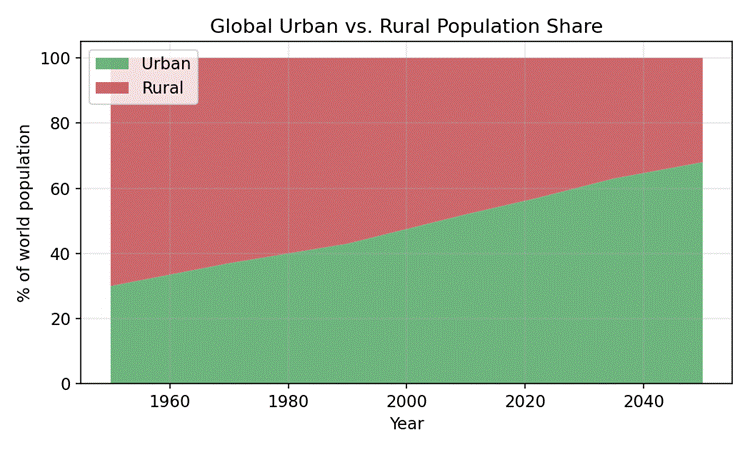
In 2007, a quiet demographic milestone passed largely unnoticed by most of the world: for the first time in human history, more people lived in cities than in rural areas. That threshold, once crossed, has continued to shift steadily in favor of urban life ever since. Today, well over half of the global population lives in urban areas, and the United Nations projects that figure will climb toward two-thirds by mid-century. This migration from countryside to city is reshaping not just where people live, but how economies function, how societies are organized, and how the planet’s resources are used.
A Long Historical Arc
Urbanization is not a new phenomenon, but its pace over the last century has been unprecedented. In 1900, only about 15 percent of the world’s people lived in urban areas; most humans throughout history lived on farms or in small villages tied to agriculture. The Industrial Revolution began changing that equation in Europe and North America, as factory jobs pulled workers into growing cities. But the truly dramatic shift has occurred in the developing world since the mid-twentieth century, as nations across Asia, Africa, and Latin America have industrialized and urbanized in a fraction of the time it took Europe to do the same.
China’s urbanization offers perhaps the starkest example. In 1980, fewer than 20 percent of Chinese citizens lived in cities; today that figure exceeds 60 percent, representing one of the largest and fastest mass migrations in human history, with hundreds of millions of people moving from rural provinces to booming coastal cities over the span of a few decades.
Figure 3: Global urban and rural population shares from 1950 through 2050, showing the steady rise of urban living.
The Rise of the Megacity
One of the most visible consequences of global urbanization has been the rise of the megacity, typically defined as an urban area with more than ten million residents. In 1950, only New York and Tokyo qualified. Today there are more than thirty such megacities, concentrated heavily in Asia, with Tokyo, Delhi, Shanghai, and Sao Paulo among the largest. Many of these cities have grown so quickly that infrastructure, housing, and public services have struggled to keep pace, producing informal settlements and slums that now house hundreds of millions of people worldwide, often lacking reliable access to clean water, sanitation, or secure housing.
At the same time, cities remain powerful engines of economic opportunity, innovation, and social mobility. Urban areas tend to offer higher wages, better access to education and healthcare, and greater diversity of employment than rural regions, which is precisely why people continue to migrate toward them despite the challenges of crowding and cost of living.
Rural Depopulation and Its Consequences
The flip side of urbanization is rural decline. As younger generations leave villages and small towns in search of opportunity, the populations left behind in rural areas skew older and smaller. This has been especially pronounced in parts of Southern and Eastern Europe, rural Japan, and increasingly rural China, where entire villages have been effectively abandoned. Agricultural land in some regions is being left fallow or consolidated into larger, more mechanized operations that require far fewer workers than traditional farming once did.
This rural-to-urban shift also has political consequences, often reshaping the balance of power between urban and rural constituencies within a country, and contributing to a growing cultural and economic divide between thriving metropolitan regions and struggling rural hinterlands, a divide that has become a significant driver of political polarization in numerous countries over the past decade.
Urban Planning Challenges
The scale and speed of contemporary urbanization has forced cities, particularly in the developing world, to grapple with challenges that wealthier cities faced more gradually over a much longer period. Housing affordability, traffic congestion, air pollution, and inadequate waste management systems are common features of rapidly growing cities that have outpaced their own infrastructure. Water scarcity is an increasingly urgent concern in fast-growing urban centers located in arid or water-stressed regions, from Cape Town to Mexico City.
Some cities have responded with ambitious planning efforts: expanding public transit networks, building affordable housing, and investing in green infrastructure to manage flooding and heat. Others have struggled to keep pace, resulting in sprawling informal development that is difficult and expensive to retrofit with basic services after the fact. How well cities manage this growth will significantly shape quality of life for the majority of humanity in the decades ahead, since urban residents are now the demographic majority worldwide.
Looking Ahead
Nearly all future global population growth is expected to be absorbed by cities, particularly in Africa and Asia, where urban populations are projected to nearly double by 2050. Lagos, Kinshasa, and Dar es Salaam are among the cities expected to see the most dramatic growth. Meeting the needs of these expanding urban populations, in housing, transportation, employment, and environmental sustainability, represents one of the central development challenges of this century, and the choices made by city planners and national governments today will shape urban life for generations of residents yet to be born.