

Population Growth and Environmental Sustainability
The relationship between human population and the natural environment has been debated by scientists, economists, and policymakers for well over two centuries, since the English scholar Thomas Malthus first warned that population growth would inevitably outstrip the earth’s capacity to feed it. Malthus’s specific predictions did not come to pass, thanks largely to agricultural innovation that repeatedly expanded the planet’s carrying capacity. But the underlying question he raised, how many people the earth can sustainably support, and at what standard of living, remains one of the central environmental questions of our time, even as the terms of the debate have evolved considerably.
Beyond Simple Numbers
Modern environmental science has moved well past the simple idea that population size alone determines environmental impact. Researchers now generally rely on a more nuanced framework, often summarized as the equation Impact equals Population multiplied by Affluence multiplied by Technology, or the IPAT formula. This framework recognizes that a small population with high per-capita consumption can generate as much or more environmental strain as a much larger population living at subsistence levels. The average resident of a wealthy nation, for instance, typically consumes many times the energy, water, and resources of the average resident of a low-income country, meaning that consumption patterns, not just headcounts, drive much of humanity’s environmental footprint.
This distinction matters enormously for how the population-environment relationship is understood. Global population growth today is concentrated overwhelmingly in regions with comparatively low per-capita resource consumption, while the regions with historically high per-capita consumption, North America, Europe, and increasingly parts of East Asia, have largely stabilized or even begun shrinking in population. This has led many researchers to argue that consumption patterns in wealthy nations bear at least as much responsibility for environmental pressure as population growth in poorer ones.
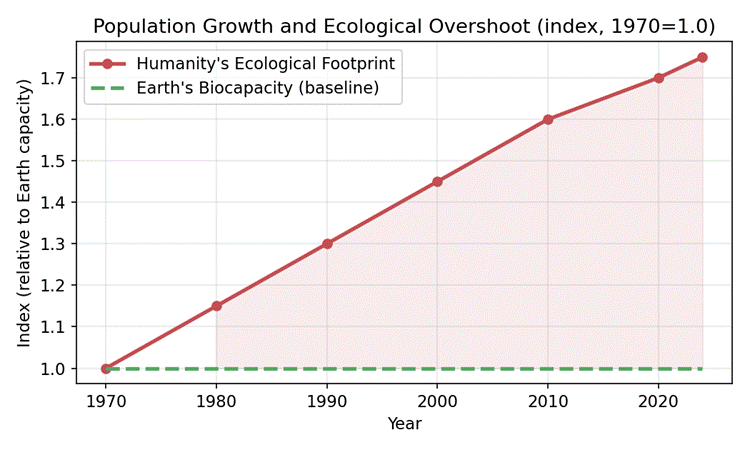
Figure 4: An illustrative index of humanity’s ecological footprint relative to Earth’s biocapacity since 1970, showing sustained overshoot.
Measuring the Strain
One widely cited measure of humanity’s environmental burden is the ecological footprint, which estimates the amount of biologically productive land and water required to produce the resources a population consumes and absorb the waste it generates, then compares that against the planet’s actual biocapacity. By this measure, humanity has been living beyond the earth’s regenerative capacity since roughly the 1970s, a state commonly referred to as ecological overshoot. Organizations that track this metric estimate that humanity currently uses resources at a rate that would require more than one and a half Earths to sustain indefinitely, with wealthy, high-consumption nations contributing disproportionately to that overshoot relative to their population share.
Climate change adds another dimension to this analysis. While global population growth contributes to rising greenhouse gas emissions in aggregate, the distribution of historical emissions has been extraordinarily uneven. A relatively small number of industrialized nations, with a comparatively small share of the world’s population, are responsible for the large majority of cumulative carbon emissions since the industrial era began, even as many of the countries now experiencing the fastest population growth have contributed comparatively little to the problem yet stand to suffer some of its most severe consequences.
Food, Water, and Land
Feeding a growing global population remains a genuine and pressing challenge, even if Malthus’s most dire predictions have not materialized. Agricultural production has kept pace with population growth over the past century largely through the Green Revolution’s high-yield crop varieties, synthetic fertilizers, and irrigation expansion, but these gains have come with significant environmental costs, including soil degradation, water pollution from agricultural runoff, and substantial biodiversity loss as natural habitats are converted to farmland. Freshwater scarcity is an increasingly urgent concern in many rapidly growing regions, particularly in parts of the Middle East, North Africa, and South Asia, where population growth and climate-driven changes in rainfall are combining to strain already limited water supplies.
Land use change driven by both population growth and rising consumption is also a major driver of biodiversity loss, as forests and other natural ecosystems are converted to agricultural or urban use to accommodate more people and their consumption needs. Some conservation scientists argue that protecting sufficient wild land to preserve global biodiversity will require careful management of both population growth and land use patterns simultaneously, rather than relying on either factor alone to ease environmental pressure.
Pathways Toward Sustainability
Given the complexity of the population-environment relationship, most researchers now advocate for approaches that address both population dynamics and consumption patterns together rather than focusing narrowly on either one in isolation. Expanding access to education and reproductive healthcare, particularly for women and girls in regions with continued rapid population growth, tends to lower fertility rates voluntarily while also improving individual welfare and human development outcomes, a genuine win-win that population researchers broadly support regardless of their views on the broader debate.
At the same time, addressing the outsized environmental footprint of high-consumption societies through cleaner energy, more efficient resource use, and shifts in consumption patterns is seen by most environmental economists as equally, if not more, important to achieving global sustainability. The encouraging news is that global population growth is already slowing on its own, driven by the same development and education trends that improve human welfare, which suggests that the more urgent and controllable lever for environmental sustainability going forward may be how humanity consumes rather than simply how many humans there are.