

Article 1: The History and Evolution of Women’s Education
For most of recorded history, formal education was treated as the near-exclusive province of men. Women were frequently barred from schools and universities altogether, or steered toward a narrow curriculum of domestic skills considered appropriate to their expected role as wives and mothers. The story of how that changed, gradually, unevenly, and often against fierce resistance, is one of the more consequential social transformations of the last two centuries, and it remains an unfinished story in many parts of the world today.
Early Restrictions and Exceptions
In ancient and medieval societies across the globe, access to formal schooling for women was rare and typically limited to the daughters of the elite, and even then usually confined to private tutoring rather than the institutions available to men. Ancient Greek philosophy generally excluded women from formal education, though notable exceptions existed, such as the philosopher Hypatia in Alexandria. In medieval Europe, convents offered some of the only avenues for women to receive an education, since nuns needed to be able to read scripture, and a handful of medieval women became recognized scholars through these religious institutions. In parts of the Islamic world during the same era, some women gained access to religious and literary education, and the founding of the world’s oldest continuously operating university, in Fez, Morocco, is credited to a woman named Fatima al-Fihri in the ninth century.
Across most societies, however, the prevailing assumption for centuries was that formal education was simply unnecessary, or even harmful, for women, whose primary roles were understood to be domestic. This assumption began to be challenged more systematically starting in the eighteenth and nineteenth centuries, as Enlightenment ideas about individual reason and rights slowly extended, incompletely and unevenly, toward questions of women’s intellectual capacity.
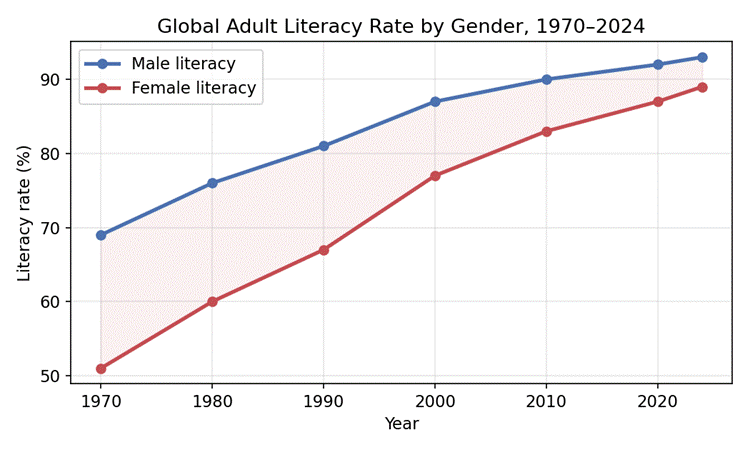
Figure 1: Global adult literacy rates by gender from 1970 to 2024, showing the narrowing but persistent gap.
The Nineteenth-Century Turning Point
The nineteenth century saw the first significant institutional breakthroughs for women’s education in the West. Oberlin College in the United States became the first coeducational institution of higher learning in 1833, and women’s colleges such as Mount Holyoke, Vassar, and Wellesley followed in subsequent decades, establishing that women could pursue rigorous academic study. In Britain, campaigners such as Emily Davies helped found Girton College at Cambridge in 1869, though women there would not be granted full degrees for many decades afterward, a reminder that access to classrooms did not always mean equal recognition of achievement.
These advances were hard-won and met with considerable resistance from those who argued, often citing pseudo-scientific claims about women’s supposedly limited intellectual or physical capacity, that higher education was unsuitable or even dangerous for women’s health. Pioneering women who pushed through these barriers, including some of the first women to earn medical degrees and doctorates, faced significant social and professional obstacles even after completing their studies, often finding professional societies and workplaces closed to them despite their qualifications.
Twentieth-Century Expansion
The twentieth century brought more rapid change, though progress remained far from universal or linear. Women gained the right to vote in many countries during the early decades of the century, a political shift that was closely linked to broader arguments about women’s capacity for education and civic participation. The expansion of public schooling systems across much of the world gradually extended access to primary and secondary education for girls, even as significant gaps with boys’ enrollment persisted, particularly beyond the primary level.
The postwar era saw further expansion, particularly in higher education, as many universities that had previously restricted or excluded women opened their doors more fully. In the United States, the passage of Title IX in 1972 prohibited sex discrimination in federally funded education programs, a landmark that significantly expanded women’s access to higher education and athletics. Around the world, newly independent nations emerging from colonial rule in the mid-twentieth century often prioritized education expansion, including for girls, as part of broader nation-building efforts, though results varied considerably depending on resources and cultural context.
A Century of Convergence, With Gaps Remaining
By the close of the twentieth century, the gender gap in primary school enrollment had narrowed substantially in most regions of the world, and in a growing number of countries, women had begun to outnumber men in university enrollment altogether, a striking reversal of the historical pattern. Yet this convergence has been highly uneven across regions, subjects of study, and levels of education. Significant gaps in girls’ access to secondary and higher education persist in parts of South Asia and sub-Saharan Africa, and even in countries where enrollment has reached near parity, women remain underrepresented in certain fields of study and in the most senior academic positions.
Understanding this long historical arc, from near-total exclusion to substantial, though incomplete, convergence, provides essential context for the challenges and opportunities that remain today. The barriers that once kept women out of classrooms entirely have largely fallen in much of the world, but as the following articles explore, new and more subtle barriers, along with persistent gaps in specific regions and fields, continue to shape whether girls and women can fully realize the benefits of education.