

Article 5: Global Policies and Programs Advancing Girls’ Education
The steady global progress in girls’ education over the past three decades did not happen by accident. It reflects a sustained, if imperfect, effort by national governments, international organizations, and civil society groups, deploying a range of policy tools that have proven effective at addressing the specific, overlapping barriers described earlier in this series. Understanding what has worked, and what remains unfinished, offers a useful guide to the challenges that lie ahead.
International Frameworks and Targets
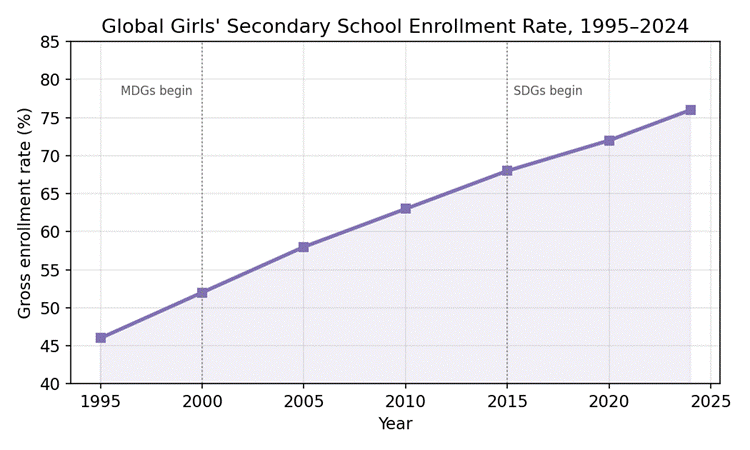
Global commitments have played an important role in mobilizing political attention and funding toward girls’ education. The Millennium Development Goals, adopted by the United Nations in 2000, included a specific target of eliminating gender disparity in primary and secondary education, a goal that, while not fully achieved by its 2015 deadline, helped drive significant gains in girls’ primary enrollment across many developing regions during that period. The Sustainable Development Goals that followed in 2015 set a broader and more ambitious target, Goal 4, calling for inclusive and equitable quality education for all, including explicit attention to eliminating gender disparities and ensuring equal access to all levels of education and vocational training by 2030, a target that remains a significant distance from being met in several regions as that deadline approaches.
Figure 5: Global girls’ secondary school enrollment rate from 1995 to 2024, spanning the MDG and SDG policy eras.
Conditional Cash Transfers and Direct Incentives
Among the most rigorously evaluated interventions in girls’ education are conditional cash transfer programs, which provide direct payments to low-income families contingent on their daughters’ school attendance. Programs of this kind, implemented at scale in countries including Mexico, Bangladesh, and Pakistan, have generally shown measurable positive effects on girls’ enrollment and attendance, particularly at the secondary level, where the opportunity cost of keeping a daughter in school tends to be highest for poor families. Bangladesh’s Female Secondary School Stipend Program, launched in the 1990s, is frequently cited as a particularly successful example, credited with contributing to a significant increase in girls’ secondary enrollment in a country that had previously seen considerably lower rates of girls’ education beyond the primary level than boys.
Beyond direct payments, some countries have experimented with related incentives, including free uniforms, textbooks, and school meal programs, all aimed at reducing the direct and indirect costs that disproportionately keep girls out of school in low-income households. School feeding programs in particular have shown consistent evidence of improving both attendance and, as a secondary benefit, nutritional outcomes for participating children.
Addressing Safety and Infrastructure
Recognizing that physical safety and school infrastructure represent significant barriers to girls’ education, numerous programs have focused specifically on infrastructure improvements, including building schools closer to underserved communities, constructing separate and private sanitation facilities for girls, and, in some contexts, providing safe transportation or escorts for girls traveling to school. Community-based schools built specifically to reduce commuting distances in rural areas have shown particular promise in several African countries, where distance to the nearest school has historically been one of the strongest predictors of girls’ non-enrollment.
Efforts to combat child marriage have also become an increasingly explicit part of girls’ education policy, recognizing the strong link between the two. A number of countries have raised the legal minimum age of marriage and strengthened enforcement, while grassroots programs in regions with high child marriage rates have worked directly with communities, religious leaders, and families to shift underlying social norms, an approach that researchers generally regard as necessary to complement legal reform, since legal minimum ages alone have often proven difficult to enforce without corresponding shifts in community attitudes.
The Role of NGOs and Civil Society
Alongside government and international programs, a wide range of non-governmental organizations have played a significant role in advancing girls’ education, often filling gaps left by public systems or pioneering approaches later adopted more broadly. Organizations such as the Malala Fund, established following the 2012 attack on education activist Malala Yousafzai, have focused specifically on advocacy and funding for girls’ secondary education in regions where access remains most limited. Other organizations have focused on specific interventions, including scholarship programs, teacher training focused on gender-responsive pedagogy, and efforts to recruit and support more female teachers, whose presence in schools has been shown in multiple studies to encourage higher enrollment and retention among girls, particularly in more conservative communities.
Remaining Challenges and the Road Ahead
Despite this substantial body of policy experience, significant challenges remain. Progress has been notably uneven, concentrated in some regions while stalling or even reversing in others, most starkly illustrated by Afghanistan’s ban on girls’ secondary and higher education since 2021. The COVID-19 pandemic also disrupted girls’ education globally in ways that are still being fully understood, with extended school closures in many countries linked to increased rates of child marriage and school dropout among adolescent girls in particular, a reminder that hard-won progress can be fragile in the face of major disruptions. Sustaining and extending the gains of the past three decades will likely require continued investment across all of the fronts described in this series: economic support for families, safe and accessible school infrastructure, efforts to shift underlying social norms, and sustained political commitment at both the national and international level to ensure that girls’ education remains a policy priority rather than an afterthought.