

Population Policy and Family Planning
Governments have attempted to influence the size and growth rate of their populations for centuries, but the tools, goals, and ethical frameworks surrounding population policy have shifted dramatically over time. Where mid-twentieth-century policies were often focused on slowing rapid growth, sometimes through coercive means, many governments today face the opposite concern: how to support aging, shrinking populations, or how to expand access to voluntary family planning as a matter of health and human rights rather than demographic engineering. This evolution reflects broader changes in how societies understand the relationship between individual reproductive choice and collective demographic outcomes.
The Era of Population Control
The mid-twentieth century saw a wave of concern about rapid population growth, driven in part by the writings of researchers such as Paul Ehrlich, whose 1968 book warning of mass famine due to overpopulation influenced policy debates for decades, even though its most dramatic predictions did not come to pass. This period produced some of history’s most consequential, and controversial, population policies. China’s one-child policy, implemented in 1980 and enforced for 35 years, is the most famous example, using a combination of financial incentives, penalties, and in some cases forced sterilizations or abortions to limit family size. The policy did significantly slow China’s population growth, but it also produced a severe gender imbalance due to a cultural preference for sons, an aging population crisis that China now faces decades ahead of schedule, and lasting social consequences that the country continues to grapple with today.
India pursued its own aggressive family planning campaigns during the 1970s, including a controversial mass sterilization program during the Emergency period that drew widespread criticism for coercive practices and human rights abuses. These historical episodes left a lasting mark on how population policy is approached internationally, contributing to a broad shift away from top-down demographic targets and toward rights-based approaches centered on individual choice.
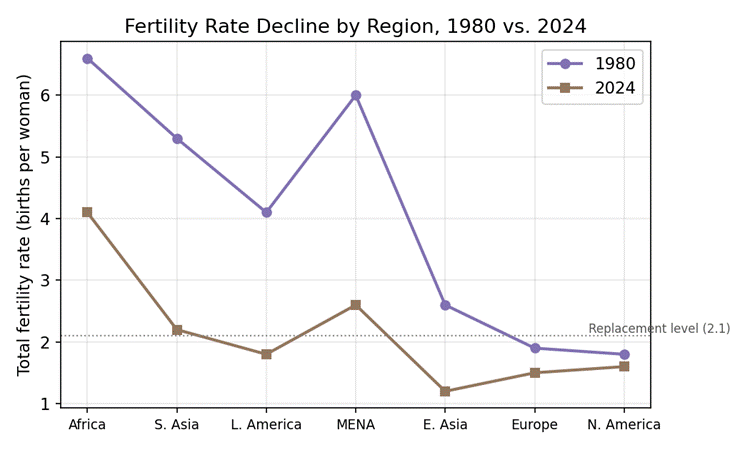
Figure 5: Total fertility rate by region, comparing 1980 with 2024, illustrating the widespread decline toward and below replacement level.
The Shift Toward Reproductive Rights
A significant turning point came at the 1994 International Conference on Population and Development in Cairo, where the international community broadly shifted its framing of population policy away from demographic targets and toward reproductive health and individual rights. The resulting consensus emphasized that family planning should be voluntary, that women’s education and empowerment were central to sustainable demographic outcomes, and that reducing population growth should be pursued as a byproduct of expanding choice and opportunity rather than as a goal imposed from above. This framework remains the dominant paradigm in international development policy today, guiding the work of organizations such as the United Nations Population Fund.
Evidence since Cairo has largely vindicated this rights-based approach on practical grounds as well as ethical ones. Countries that have invested in girls’ education, expanded access to contraception, and improved maternal and child health have generally seen fertility rates decline steadily and voluntarily, often faster than coercive programs achieved in earlier decades, while also improving broader measures of human welfare and gender equality along the way.
Pro-Natalist Policies in Aging Nations
As fertility rates have fallen below replacement level across much of the developed world and increasingly in middle-income countries as well, a growing number of governments have pivoted toward pro-natalist policies aimed at encouraging, rather than discouraging, childbearing. Hungary has implemented some of the most aggressive measures, including generous tax exemptions for mothers of multiple children and subsidized loans that are partially forgiven with each additional child born. France has long maintained one of Europe’s more robust family support systems, combining subsidized childcare, extended parental leave, and direct cash benefits, and has correspondingly maintained a somewhat higher fertility rate than many of its neighbors, though it too has recently seen fertility fall closer to other European countries.
South Korea, facing the lowest fertility rate of any country in the world, has poured enormous public resources into incentive programs, yet these efforts have so far had only a modest measurable effect, illustrating a pattern seen across many aging societies: once fertility falls significantly below replacement level, reversing that trend through financial incentives alone has proven remarkably difficult. Researchers point to a complex mix of underlying causes, including housing costs, demanding work cultures, and shifting social norms around marriage and career, that financial incentives alone rarely address.
The Immigration Alternative
Faced with the limited success of pro-natalist policy, many aging nations have turned instead to immigration as a more immediate lever for stabilizing or growing their working-age populations. Canada, Australia, and Germany have all pursued relatively open immigration policies partly in response to demographic pressures, using points-based systems or targeted labor programs to attract younger workers who can help offset an aging native-born population and support strained pension and healthcare systems. This approach carries its own political complexities, as debates over immigration levels and integration remain contentious in many of these same countries, but demographically it has proven more immediately effective than efforts to raise birth rates directly.
Looking Forward
Population policy today looks quite different from the demographic engineering of the twentieth century. The emerging consensus among researchers and international bodies is that the most effective and ethical population policies are those that expand individual choice, through education, healthcare access, and economic opportunity, rather than those that attempt to impose demographic outcomes from above, whether by restricting births or by aggressively incentivizing them. As the world’s demographic map continues to diverge, with some regions still growing and others shrinking, the policy toolkit available to governments will likely continue to expand, but the lesson of the past half-century suggests that policies working with individual choice tend to outperform those working against it.