

Article 2: Barriers to Girls’ Education Around the World
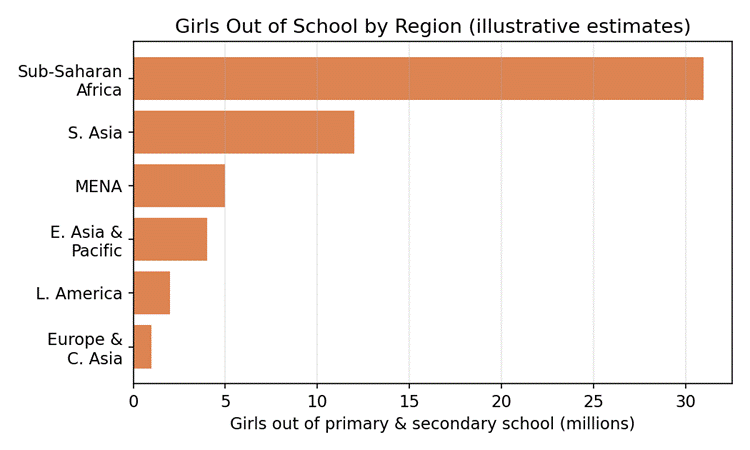
Despite decades of progress, an estimated 122 million girls remain out of school worldwide, according to UNESCO figures, concentrated disproportionately in sub-Saharan Africa and parts of South Asia and the Middle East. The reasons girls are denied an education are rarely singular; they typically involve an overlapping web of economic, cultural, logistical, and safety-related obstacles that compound one another, and understanding this complexity is essential to designing policies capable of addressing it effectively.
Poverty and the Cost of Schooling
Economic hardship remains one of the most significant barriers to girls’ education globally. Even where public schooling is nominally free, families often face substantial indirect costs, including uniforms, textbooks, supplies, and transportation, that can be prohibitive for low-income households. When resources are scarce, many families make difficult decisions about which children to prioritize for continued schooling, and deeply entrenched cultural norms in many societies still lead families to prioritize sons over daughters in these situations, reasoning that investment in a son’s education will yield a more direct return to the family, particularly in contexts where daughters are expected to marry into another household.
The opportunity cost of girls’ time also plays a significant role. In many low-income and rural communities, girls are relied upon for domestic labor, including collecting water and firewood, caring for younger siblings, and helping with agricultural work, tasks that compete directly with time spent in school. Studies in various developing regions have found that girls in rural households often spend markedly more hours per week on unpaid domestic labor than their brothers, a disparity that begins early and compounds over years of schooling.
Figure 2: Estimated numbers of out-of-school girls by world region, illustrating the concentration of the challenge.
Child Marriage and Early Pregnancy
Child marriage remains one of the most powerful drivers of girls dropping out of school in many parts of the world. According to UNICEF estimates, roughly one in five young women globally were married before the age of eighteen, and in some countries that figure is considerably higher. Once married, girls are frequently expected to leave school entirely to take on domestic responsibilities, and early pregnancy, whether within marriage or otherwise, poses a further significant barrier, as many school systems have historically excluded pregnant students or young mothers, either through formal policy or informal stigma, though a growing number of countries have introduced re-entry policies in recent years to help young mothers resume their education.
Safety, Distance, and Infrastructure
Physical safety and access present another major set of obstacles. In many rural areas, the nearest secondary school may be many kilometers from a girl’s home, requiring a long and sometimes unsafe commute, a concern that weighs particularly heavily on families worried about harassment or violence against daughters traveling alone or after dark. Where schools are within reach, inadequate infrastructure, including a lack of separate and private sanitation facilities for girls, has been shown in numerous studies to contribute significantly to absenteeism and dropout, particularly once girls reach adolescence.
Conflict and humanitarian crises compound all of these challenges considerably. Girls in conflict-affected regions are significantly more likely to be out of school than boys in the same areas, and armed groups in some regions have specifically targeted girls’ education, most infamously in the case of the 2014 kidnapping of schoolgirls in Chibok, Nigeria, and the Taliban’s restrictions on girls’ secondary and higher education in Afghanistan since 2021, restrictions that have made Afghanistan the only country in the world where girls are currently barred from secondary school entirely.
Cultural Norms and Expectations
Beyond these structural barriers, deeply held cultural attitudes about the appropriate role and value of women’s education continue to shape outcomes in many communities, even where legal and economic obstacles have diminished. In some contexts, girls’ education beyond a certain point is viewed with suspicion, seen as unnecessary for a future centered on marriage and domestic life, or even as a threat to family honor or a girl’s marriageability. Changing these underlying social norms has generally proven to be a slower and more complex process than removing formal legal barriers or building physical school infrastructure, requiring sustained community engagement rather than policy change alone.
A Compounding Problem
What makes girls’ education such a persistent global challenge is the way these barriers reinforce one another. Poverty increases the likelihood of child marriage; child marriage increases the likelihood of dropping out; dropping out reduces a girl’s future earning potential, which in turn perpetuates the poverty that constrained her family’s choices in the first place. Effective interventions, as later articles in this series explore, have generally needed to address multiple barriers simultaneously rather than treating any single obstacle in isolation, recognizing that a girl kept out of school by economic pressure, unsafe infrastructure, and social expectation all at once will rarely be reached by a solution addressing only one of those forces.