

Population Aging Around the World
While much of the twentieth century’s population conversation centered on rapid growth, the defining demographic story of the twenty-first century is aging. As birth rates fall and life expectancy rises, the median age of populations across much of the world is climbing steadily. What was once considered a phenomenon confined to wealthy, industrialized nations is now a global trend, reaching middle-income countries far sooner in their development than it did for the nations that industrialized first. This shift carries profound implications for economies, healthcare systems, pension programs, and the basic shape of family life.
The Mechanics of an Aging Population
Population aging occurs when the share of older people in a society grows relative to younger age groups. This happens through two intertwined forces: people are living longer, and fewer children are being born to replace them. Life expectancy gains, driven by advances in medicine, nutrition, and public health, mean that a person born today in most parts of the world can expect to live decades longer than someone born a century ago. At the same time, fertility rates have fallen sharply almost everywhere, from an average of roughly five children per woman globally in 1960 to about 2.3 today, with many countries well below the replacement threshold.
The combination produces a population pyramid that is no longer a pyramid at all. Historically, population structures resembled a wide-based triangle: many children at the bottom, tapering to relatively few elderly at the top. In rapidly aging societies, that shape is inverting into something closer to a column or even an upside-down pyramid, with roughly equal numbers at each age band, or more people in older cohorts than younger ones.
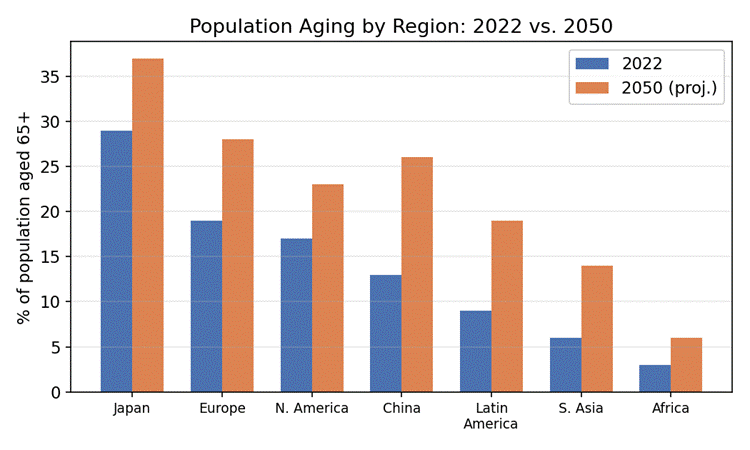
Figure 2: Share of population aged 65 and older by region, comparing 2022 with 2050 projections.
Japan as the Leading Edge
Japan offers the clearest preview of where much of the world is heading. Nearly a third of its population is already 65 or older, the highest share of any large nation. Japan’s workforce has been shrinking for years, its rural towns are depopulating, and the country has had to rethink everything from immigration policy to robotics investment in response. Schools have closed for lack of children to fill them, while demand for elder care services has surged. Japan’s experience is being watched closely by policymakers elsewhere, both as a warning and as a source of practical lessons on adaptation.
China is following a similar trajectory but on a much larger scale and a faster timeline, a legacy in part of its decades-long one-child policy combined with rapid economic development. China’s population began shrinking in the early 2020s, years earlier than most demographers had anticipated, and its working-age population is now contracting even as the number of retirees grows. South Korea, Italy, and much of Eastern Europe face comparable pressures, with fertility rates among the lowest in the world.
Economic and Social Consequences
An aging population reshapes the fundamental arithmetic of an economy. Fewer working-age people must support a larger number of retirees, straining pension systems that were often designed decades ago when the ratio of workers to retirees was far more favorable. Healthcare costs tend to rise as populations age, since older adults generally require more medical care. Labor shortages can emerge in sectors ranging from manufacturing to caregiving itself, sometimes prompting governments to raise retirement ages, encourage immigration, or invest heavily in automation to offset the shrinking workforce.
There are social consequences as well. Family structures shift when there are fewer siblings, cousins, and children in a society; the traditional model of family-based elder care becomes harder to sustain as extended families shrink. Housing markets, consumer spending patterns, and even political priorities tend to shift as the median voter grows older, with policy debates increasingly centered on healthcare, pensions, and long-term care rather than schools or family benefits.
Policy Responses
Governments have tried a range of approaches to soften the effects of aging. Some, including France and several Nordic countries, have invested heavily in family-friendly policies such as subsidized childcare, generous parental leave, and cash incentives for larger families, though results have generally been modest at best; fertility rates have proven remarkably resistant to policy intervention once they fall below replacement level. Other countries have leaned on immigration to replenish their working-age populations, a politically contentious but demographically effective strategy in places like Canada and Germany. Still others are investing in automation and productivity gains to offset a shrinking labor force rather than trying to reverse the demographic trend itself.
Raising the retirement age has become almost universal among aging societies, though it remains politically difficult, as seen in the public backlash that followed pension reforms in France and elsewhere. Some economists argue that the more sustainable long-term response is not to fight demographic change but to adapt to it: redesigning cities, workplaces, and health systems around the reality of older, smaller populations rather than assuming a return to the growth patterns of the twentieth century.
What makes today’s aging trend distinct from earlier eras is its global reach. Population aging is no longer confined to Japan and Western Europe; it is now underway in Thailand, Brazil, Iran, and dozens of other middle-income countries, often before they have reached the income levels that allowed earlier aging nations to build robust pension and healthcare systems. This ‘aging before growing rich’ pattern presents a distinct policy challenge, and how these countries navigate it, balancing economic development with the needs of a rapidly graying population, will be one of the more important economic stories of the coming decades.