

World Population Growth and Trends
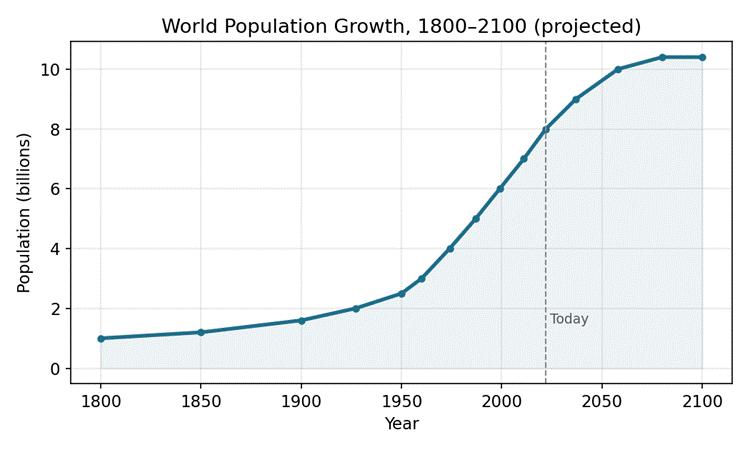
For most of human history, population growth was so slow that it was barely perceptible within a single lifetime. It took until roughly the year 1800 for the world’s population to reach one billion people, a milestone that had been building for tens of thousands of years since the first humans walked out of Africa. Yet in the span of little more than two centuries since, that number has grown eightfold. Today, more than eight billion people share the planet, and demographers project the total will approach, but likely never far exceed, ten to eleven billion before the century is out. Understanding how this happened, and what comes next, is one of the more remarkable stories in modern history.
From Slow Growth to Explosion
The dramatic acceleration in population growth over the past two hundred years is closely tied to the Industrial Revolution and the scientific advances that followed it. Before the 1800s, birth rates were high, but so were death rates: famine, disease, and poor sanitation kept average life expectancy low and infant mortality brutally high. Population grew, but painfully slowly, checked constantly by the same forces that produced it. The turning point came with public health improvements, cleaner water, vaccination, and eventually antibiotics, which caused death rates to fall sharply while birth rates, shaped by cultural and economic habits, remained high for a generation or two longer. That gap between falling deaths and still-high births is what demographers call the ‘demographic transition,’ and it is the engine behind the population explosion of the twentieth century.
The numbers illustrate the pace of change vividly. The world added its second billion people by 1927, only 127 years after the first. The third billion took just 33 years, arriving in 1960. The fourth came in 14 years, the fifth in 13, and by the early 1990s the world was adding roughly a billion people every dozen years. Growth peaked in relative terms in the late 1960s, when the global population was expanding by more than 2 percent annually. Since then, the rate of growth has been slowing steadily, even as the absolute numbers added each year remained large because the base population had grown so much larger.
Figure 1: World population growth from 1800 to projected 2100, showing the sharp rise of the 20th century and a leveling curve ahead.
Where Growth Is Happening Now
Population growth today is highly uneven across the globe. Much of East Asia, Europe, and North America has already completed the demographic transition; birth rates in these regions now sit at or below the replacement level of about 2.1 children per woman, meaning populations there are stable, aging, or in some cases already shrinking. The story is very different in parts of sub-Saharan Africa, where fertility rates remain considerably higher and populations continue to grow rapidly. Nigeria, for example, is projected to become one of the most populous countries on Earth within the coming decades, and the African continent as a whole is expected to account for the majority of global population growth through the rest of this century.
South Asia presents a middle case. India recently surpassed China to become the world’s most populous nation, even though its fertility rate has fallen close to replacement level in most states. This is a result of demographic momentum: a large share of India’s population is young and of childbearing age, so even modest fertility rates translate into large absolute numbers of births for another generation or two before growth naturally tapers off.
Why Growth Is Slowing
The single most consistent predictor of falling birth rates across cultures and continents is not government policy but the expansion of opportunity for women. As girls gain access to education and women gain access to the workforce, family sizes shrink almost everywhere this has been studied. Urbanization plays a similar role: children who were once economic assets on a family farm become, in a city apartment, primarily a cost rather than a source of labor. Falling infant and child mortality also matters. When parents can be confident their children will survive to adulthood, they tend to have fewer of them, investing more resources in each child rather than having many as a hedge against loss.
Economic development, healthcare access, and the availability of contraception all reinforce this pattern. Countries that invest early in girls’ education and reproductive healthcare tend to see fertility decline faster and population growth stabilize sooner than countries that do not. This is why demographers increasingly view population trends less as a force of nature and more as a downstream consequence of social and economic choices.
What the Future Might Look Like
Most demographic models now suggest that the era of runaway global population growth is ending. The United Nations’ median projection has the world population peaking somewhere around 10.3 billion in the 2080s before beginning a slow decline. Some independent research groups, drawing on faster fertility declines than the UN assumes, project an earlier and lower peak, arguing that global population could begin shrinking as soon as the 2060s. The uncertainty in these projections is substantial, because a great deal depends on choices not yet made: how quickly fertility falls in Africa, how migration patterns shift, and how life expectancy continues to change.
What is far less uncertain is that the character of population growth has changed. The twentieth century was defined by rapid, broad-based increase. The twenty-first century will likely be defined by divergence: some regions aging and shrinking while others continue to grow, at least for a few more decades. That divergence, rather than the raw global total, may turn out to be the more consequential population story of our time, reshaping everything from labor markets and pension systems to migration flows and geopolitical power for generations to come.